Welcome: KANGMINGTANG TRADING
Language:
 ∷
∷

∷
∷
Recently, the film A Letter to Grandma touched many viewers with its quiet and emotional storytelling.
It reminded people of an older generation of overseas Chinese — those who left their hometowns for Southeast Asia, carrying with them memories, family ties, and hopes for a better life.
For many Chinese families in Southeast Asia, home is not only found in old photographs or faded letters.
Sometimes, home lives in a familiar dialect, an old song, or simply in a cup of herbal tea.
In Guangdong, Hong Kong, Macau, and many Southeast Asian Chinese communities, herbal tea has long been part of daily life.
Older generations often said:
“The weather is hot — drink some herbal tea.”
“Too much fried food — drink some herbal tea.”
“Feeling heaty after staying up late — drink some herbal tea.”
It was never considered a fashionable beverage or luxury product.
Instead, it was a simple household habit passed down through generations.
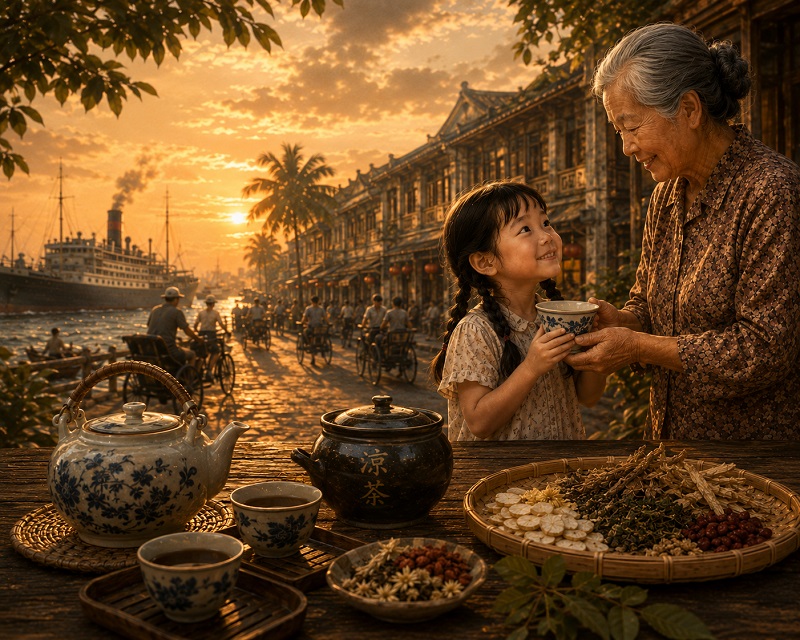
For many families, herbal tea represented care from elders.
As children came home from school, a warm cup of herbal tea might already be waiting on the table. After eating fried snacks, grandparents would gently remind them:
“Have some herbal tea.”
These small moments may have seemed ordinary at the time, but years later, they become some of the warmest memories of home.
Because in many Chinese families, love is often expressed quietly — through everyday actions rather than words.
From the late Qing Dynasty through the modern era, many people from Guangdong, Fujian, and Chaoshan traveled to Southeast Asia in search of opportunity.
They brought with them not only their language and traditions, but also their way of life.
Herbal tea was one of those traditions.
The hot and humid climate of Southeast Asia was similar to Lingnan in southern China, making herbal tea naturally suitable for local living habits. Over time, herbal tea became deeply rooted in Chinese communities across Malaysia, Singapore, Thailand, and Indonesia.
Even today, many older overseas Chinese families still keep herbal tea at home.
Because for them, drinking herbal tea is not just about taste — it is about remembering where they came from.
What makes A Letter to Grandma so touching is its reminder that some emotions are never spoken directly.
Older generations of Chinese families were often not used to saying “I love you.”
Instead, they expressed care in quieter ways.
Sometimes it was a handwritten letter.
Sometimes it was a home-cooked meal.
And sometimes, it was simply a cup of herbal tea.
The slightly bitter yet soothing taste of herbal tea often carried the warmth of family care behind it.
“Remember to drink some herbal tea — the weather is hot.”
Simple words like these contained concern, protection, and love.
Many overseas Chinese understand this feeling deeply.
Because no matter how far people travel from home, the way elders care for family rarely changes.
In the past, preparing herbal tea required buying herbs, washing them, slowly boiling them, and letting them cool.
Today, life moves much faster. Many younger families no longer have time to prepare herbal tea the traditional way every day.
As a result, herbal tea bags and cold-brew herbal teas have become more popular in modern households.
What we hope to preserve is not only the herbal flavor itself, but also the sense of familiarity and comfort connected to Chinese family culture.
Whether in Hong Kong, Singapore, Kuala Lumpur, Sydney, or Vancouver, a simple herbal tea bag can bring back memories of home:
the gentle aroma of tea in the kitchen,
and the quiet care once given by grandparents.
To many people outside Chinese culture, herbal tea may seem unusual at first.
But for Chinese families, it has always been something deeply connected to daily life.
It is not as intense as coffee, nor as sweet as soda.
Instead, it quietly accompanies everyday moments — during hot afternoons, after family meals, or while sitting together and talking.
And through generations of overseas Chinese, this herbal tea culture continued to travel across oceans and borders.
Younger generations today may not brew herbal tea the same way their grandparents did, but when they smell that familiar herbal aroma, many still think of home.
A Letter to Grandma reminds us that some emotions remain, even across time and distance.
Herbal tea is much the same.
It traveled from Lingnan to Hong Kong and Macau, then followed overseas Chinese communities to Southeast Asia and around the world.
It is more than just a herbal beverage.
It is a memory of home.
A connection between generations.
A quiet part of Chinese family culture.
Years later, people may forget the exact words written in old family letters.
But many will still remember:
a warm afternoon,
and a cup of herbal tea waiting quietly on the table.
Contact: KMT Trading
Phone: +86-13152503901
Tel: +86-13152503901
Email: [email protected]
Add: No.2,Jinlong Road, Nanning,Guangxi,China